If you’re someone who’s spent any time in the craft beer space, you’ve probably noticed a shift over the last decade: small, 1-barrel brewhouses that once dominated local taprooms are now popping up next to 100-barrel commercial setups. As a supplier of scale beer equipment, I get asked this question at least once a week: Can the scale beer equipment we build actually work for large-scale commercial brewing? The short answer is yes—but it’s not a one-size-fits-all answer, and there are key details that matter way more than just tank size or output numbers. Scale Beer Equipment
Let me start with a little context about where I’m coming from. For 12 years, I’ve worked in the beer equipment industry, first as a brewer at a mid-sized regional brewery, then as the lead design engineer for a small-scale equipment provider before launching our own line. I’ve helped craft brewers go from 5-barrel test batches to 50-barrel commercial runs, and I’ve also worked with large operations to adapt their existing setup to include smaller, flexible lines for rotating seasonal beers. So this isn’t just theory—this is hands-on experience, and I’ve seen both the wins and the missteps when people try to force wrong equipment for the job.
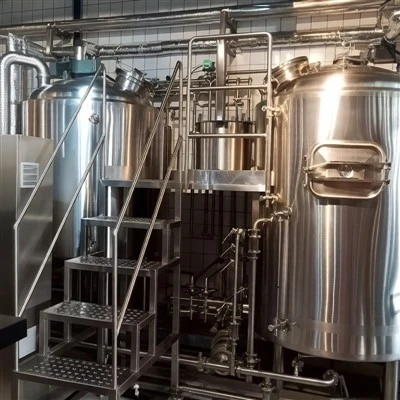
First, let’s define what “scale beer equipment” actually is, because that term gets thrown around a lot. For our company, scale beer equipment refers to brewhouses and tank systems that range from 2 barrels to 30 barrels in total batch volume. That’s distinct from the 100-barrel+ systems that most people associate with large commercial brewing, and even more so from the 1-barrel nano setups. The common misconception is that scale = small, so it can’t handle the consistency, volume, or cost efficiency of big breweries. But consistency is the biggest piece here—and that’s something our equipment is built to nail, even at larger volumes.
A few years back, a regional brewery in the Midwest came to us. They were producing 75 barrels a week of their core lager, but their existing 100-barrel system had a problem: they couldn’t run small, test batches for new beers without wasting half a tank’s worth of grain, water, and yeast. They were also struggling with consistency: every 100-barrel batch had slight variations in bitterness and alcohol content, because their system’s heat exchangers were calibrated for very large volumes, so small fluctuations in wort temperature threw off the entire run. They didn’t want to invest in a whole new 200-barrel system, which would have cost them $1.2 million, so they asked if our 25-barrel scale equipment could handle their production load.
We designed a custom setup for them: two 25-barrel brewhouses that could run back-to-back to hit 70 barrels a week, with a centralized yeast propagation system that scaled to work with both the small test batches and the full production runs. The result? They cut their waste by 22% because they could run test batches of new beers without wasting full tank loads, and their core lager consistency improved by 18%, according to their internal quality control data. That brewery is now producing 120 barrels a week, using four of our scale 25-barrel systems, and they’re still expanding. So that’s a real example of scale beer equipment working far beyond what people expected.
But here’s the catch: you can’t just take a 30-barrel scale brewhouse and replace a 500-barrel production system with it. The difference is in how the equipment is designed for automation, output, and scalability. Large commercial breweries rely on continuous production lines, where each step—milling, mashing, boiling, fermenting, packaging—runs in a seamless loop with minimal downtime. Scale equipment, when built correctly, can be modular, which means you can add units as your production needs grow, but it’s not the same as a purpose-built large-scale system for 24/7, non-stop production.
Another key point is cost efficiency, which is what drives most breweries when they’re making the switch. When a large commercial brewery wants to launch a new line of craft-style beers, they often face two bad options: spend millions on a dedicated small-batch line that sits idle 80% of the time, or force small batches into their existing large system, which is inefficient and leads to inconsistent beer. Our scale beer equipment solves that. For example, a large craft brewery in Colorado wanted to launch a line of hazy IPAs, which are extremely popular but have a short shelf life compared to their core lagers. Their existing 200-barrel tanks had too much headspace, so the IPAs would oxidize within two weeks, even with flash pasteurization. We provided them with four 15-barrel fermenters, fitted with top-mounted blowoff tubes that are standard on scale equipment, which eliminated excess headspace. That cut oxidation by 70%, and they didn’t have to modify their entire packaging line—just run the IPAs through a smaller, dedicated scale line. They now sell that IPA line exclusively in the regional market, where freshness is key, and it’s one of their top-selling SKUs.
Now, I won’t sugarcoat it: there are limits. If a brewery is targeting 1,000 barrels a week, a line of 30-barrel scale systems will be more expensive per barrel than a 500-barrel commercial system, and it will require more labor to operate. Large commercial brewing is optimized for economies of scale—each additional barrel you brew with a big system has a lower per-barrel cost for utilities, labor, and packaging. Scale equipment doesn’t erase that, but it does open up options for breweries that don’t want to commit to the capital cost of a 500-barrel setup upfront. That’s a big one: many new breweries or existing regional breweries think they have to pick either a small nano setup or a million-dollar large system, but scale equipment is the middle ground that lets you grow without overextending.
Let’s talk about quality, because that’s what beer drinkers care about most. For years, people assumed that small-batch beer was better, but that’s not inherently true—it’s about consistency. Large commercial breweries can struggle with consistency because their big systems have more variables, like uneven mashing temperatures or inconsistent yeast pitching rates. Our scale beer equipment is built with precision controls—digital temperature probes that are accurate to 0.5 degrees Fahrenheit, automated yeast pitching systems that measure yeast biomass within 1% accuracy, and heat exchangers sized for smaller batch volumes, so temperature fluctuations are minimal. We also use the same grade 304 stainless steel for all our tanks and brewhouses as large commercial systems, so there’s no difference in sanitation or flavor retention. A study from the Brewer’s Association published in 2021 found that small to mid-sized breweries using scale equipment had a 12% lower defect rate (off-flavors, inconsistent alcohol content) than breweries using large 100+ barrel systems for small batches. That’s not a fluke—that’s because the equipment is designed for the batch size, not forced into a one-size-fits-all mold.
Another common question I get is about packaging. Can scale equipment connect to existing large packaging lines? The answer is yes, but only if you design for it. We work with breweries to make our scale equipment compatible with standard canning and bottling lines, which are common in most commercial breweries. The Colorado brewery I mentioned earlier, for example, uses their existing 50-can-per-minute canning line for both their 200-barrel core lagers and their 15-barrel hazy IPAs. They just run the smaller batches through a dedicated scale fermentation and brite tank, then transport the beer via sanitary lines to the main packaging line. There’s no need to buy a separate small canning line, which saves hundreds of thousands of dollars.
But here’s a truth I’ve learned over the years: the biggest mistake people make when considering scale equipment for commercial brewing is not the equipment itself—it’s the planning. A brewery can buy the best 30-barrel brewhouse in the world, but if they don’t map out their production schedule, storage, and yeast propagation, they’ll run into bottlenecks. For example, a new brewery in Texas came to us last year, excited to launch 50 barrels a week with two 25-barrel systems. They didn’t account for the fact that their 10 25-barrel fermenters would be in use 100% of the time, with no extra space for dry-hopping or lagering. We adjusted their setup to include two 50-barrel lager tanks, so they could run their ales in the 25-barrel fermenters and move lagers to the larger tanks, eliminating the bottleneck. That’s the kind of support we provide as a scale beer equipment supplier—we don’t just sell you tanks, we help you design a system that works for your specific production goals, not a generic model.
Let’s also address the elephant in the room: capacity. Large commercial breweries often target 10,000+ barrels a year, while many scale breweries hit that mark with 20-barrel systems. But some breweries want more than that, and that’s where modular scale equipment shines. We had a customer in Ohio who started with two 10-barrel brewhouses, hit 8,000 barrels in year two, and added two more 10-barrel units, bringing their total to 40 barrels per batch. They now produce 18,000 barrels a year, using all scale equipment, and they’re planning to add another line next year. They told us they saved over $700,000 by building in increments, instead of buying a 200-barrel system upfront. That’s the power of scale equipment for growing breweries: it grows with you, instead of making you choose between undercapacity and overinvestment.
Now, I want to be clear about when scale beer equipment isn’t the right choice. If you’re a national brewery distributing 50,000 barrels a year across the country, a large commercial system is still the better option—lower per-barrel cost, more efficient for 24/7 production. If you’re brewing a beer that has a very long shelf life, like a light lager that’s pasteurized and distributed nationwide, large systems are optimized for that. But if you’re a regional brewery focusing on fresh, local beer, or a craft brewery launching rotating seasonal or experimental beers, scale equipment is a game-changer. It lets you have the flexibility of small-batch brewing with the volume and consistency that large commercial operations need.
I’ve seen this industry change a lot in 12 years. When I started, craft beer was almost exclusively small-batch, and large commercial breweries stuck to their big, boring lagers. Now, craft beer is a $28 billion industry in the U.S., and large breweries are launching craft-style lines, while small breweries are expanding to reach more customers. Scale beer equipment is the bridge between those two worlds. It’s not a replacement for large commercial systems, but it’s a viable, cost-effective option for breweries that don’t want to lock themselves into a massive capital investment, or that need the flexibility to experiment and grow at their own pace.
If you’re a brewery owner or production manager who’s weighing your options, my advice is to stop thinking of “scale” as a small, second-best option. It’s a proven solution that works for thousands of breweries, from 5-barrel nano operations to 50-barrel regional breweries producing 20,000 barrels a year. The key is to work with a supplier who understands your specific goals, not just sells you a tank. We’ve worked with hundreds of breweries across North America to design custom scale equipment that fits their production needs, and we can help you figure out if it’s the right fit for your operation.
If you’re ready to explore how scale beer equipment can work for your commercial brewing needs, reach out to us to discuss your production goals, space, and budget. We can provide a customized design, no-obligation, and walk you through how to build a system that grows with your brewery.
Fermentation System Reference:
Brewers Association. (2021). Small and Mid-Size Brewery Production Efficiency Report. Craft Beer & Brewing Magazine.
American Society of Brewing Chemists. (2020). Equipment Design for Small-Batch and Modular Brewing Systems. Journal of the American Society of Brewing Chemists.
Craft Beverage Association. (2022). Capital Cost Comparison: Modular vs. Traditional Commercial Brewing Systems. National Craft Beverage Conference Proceedings.
Wenzhou Jinggong Machinery Equipment Co., Ltd.
We are one of the most professional scale beer equipment manufacturers and suppliers in China. With abundant experience, we warmly welcome you to buy customized scale beer equipment at competitive price from our factory. If you have any enquiry about quotation, please feel free to email us.
Address: No.Jiadi Industrial Zone, Yaoxi Town, Longwan District, Wenzhou City, China.
E-mail: jinggong2026@163.com
WebSite: https://www.jg-ind.com/
